By Eric Zedalis
It was the end of Fall semester 2013, a week before Marlena Wright, then a sophomore student-athlete on the UDC women’s cross country and track & field team, was to return home to Bronx, N.Y. for Christmas. She walked over to the UDC Sports Complex with her boyfriend, Phil Foster, a junior defenseman on the UDC men’s lacrosse team.
“Our grades had just come out, and I wasn’t very happy with mine. But [Phil] was, because he had mostly A’s and B’s,” Wright said. “I had mostly C’s.”
While Foster paid a visit to Senior Associate AD, Joe Lang at his office, Wright sat down outside on the hallway floor, her back against the yellow concrete wall. She began to ask herself a series of questions:
“Why? Why am I continuously putting myself and my parents in the position to be disappointed? I’m not dumb…I know what I am capable of. So why am I not even trying to live up to those expectations I have of myself?”
Wright did not have a good answer for any of those questions, and it was at that point she identified the problem.
“I was doing bad not because of anything but just because.”
When Foster walked out of Lang’s office, he immediately noticed Wright was upset. He asked what was wrong, and Wright, holding back tears, explained why she was disappointed.
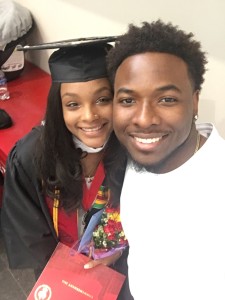
Marlena Wright and boyfriend Phil Foster on graduation day May 2016. Foster graduated a year prior with a 3.25 GPA and now started his own business as a Cinematographer and Entertainer.
Foster then told Wright the story of how he wound up at UDC. A Baltimore, Md. native, Foster first attended Morgan State and then Dean College before finally finding the right fit at the University of the District of Columbia.
“My freshman year of college, my GPA was a 1.9. I had professors say to me ‘school isn’t for everyone’,” Foster explained. “After a disappointing year, I looked in the mirror and realized I didn’t try.”
Wright saw parallels between her and Foster’s stories, and he helped her realize there was a simple solution.
“Phil told me that if I didn’t like how I was doing, then all I had to do was just change it,” she said. “I know this advice sounds so simple, but it is often the simplest solutions to problems that we tend to overlook.”
While Foster’s advice resonated with Wright, it was perhaps appealing to her competitive side that really gave Wright the push she needed to apply herself academically.
“I challenged her that my grades would be higher than hers, and I’d graduate Cum Laude. She really took that to heart, and so I ended up losing that challenge,” he laughed. (Foster would however complete his Communications degree in 2015 with a 3.25 overall GPA)
Wright recalled taking a few classes with Foster his final year at UDC, including a photography class where the competition really began to intensify.
“I remember our first test in Photography, I got the highest grade in the class. He won’t admit it, but he was a little salty,” Wright joked.
However much the competition with Foster motivated her, Wright still had a psychological obstacle to overcome.
“This might come as a surprise to some, but I am a very lazy person. If I could just lie in front of my computer screen all day binge-watching Netflix, then I would,” she confessed. “The only way for me to overcome that laziness is to keep my whole day busy. I get a lot done when I work on a very tight schedule, because I have no time to really sit and think about how much I’d rather be watching Glee or Scandal. Realizing this, and owning it…my mindset from that point on was to keep busy.”
Next, if she was to keep busy, Wright needed the confidence to put herself out there and get involved. An admittedly introverted person, Marlena says that if not for track & field, she might not have even attended college.
“Track was my motivation to go to school, and I didn’t want to fail any classes, because I wanted to make sure that I was eligible to run. Athletics made it possible for me to come to college and to discover and find myself inside and out of the Sports Complex.”

Wright’s 4x400M Relay Team at 2014 Penn Relays. They were first UDC relay team to reach a final at Penn Relays.
One particular moment in her collegiate athletic career completely changed her outlook and gave her the confidence to become a leader on campus. On a Saturday night, April 26th, 2014, Wright and three of her teammates became the first Firebird relay team to compete in the finals of the Women’s College 4x400M event at the 120th inception of the world’s oldest and largest relay carnival – Penn Relays. In front of a captive audience of over 49,000 at historic Franklin Field, Wright and her teammates soared to a time of 3:44.99 seconds to finish 6th place overall. Their time was over two seconds faster than their previous season-best, which was their heat-winning time of 3:47.18 run in Thursday’s preliminary round.
With that performance under her belt, certainly any fear of involvement or public speaking was put to rest.
“I often tell people that if I can run in front of thousands of people, where thousands of things could have gone wrong, then I can speak in front of anyone.”
And if that was not enough to lift her confidence, later that spring, Wright and her 4x400M Relay team of Kaydian Jones, Jerily Benjamin and Simone Grant, went on to place 4th at the NCAA Division II Outdoor Track & Field Championships and set a school record with a time of 3:42.63. She earned her second All-American honor of that year for that performance after the same team had earned All-American status by placing 6th at the Indoor Championship back in March. Wright also was a key contributor in helping the Firebirds secure a sweep of the East Coast Conference Indoor & Outdoor Championships in 2013-14.
During this fairy tale of a sophomore season, Wright also managed to have her best academic semester to date, earning all A’s and B’s her spring semester 2014. Already in just two short years, Wright was a two-time All-American, part of three ECC Championship teams, and she had finally found her footing academically. Yet, she still felt as though she was limiting her own potential.
“Somewhere along the way, I learned that – like Muhammad Ali said – people should be judged by how they use their talent to help others and better their communities. That is the goal,” she said.
Lucky for Wright, she competes in an NCAA division designed to not only provide a life balance between academics and athletics, but to create opportunities for student-athletes to learn and gain experience that will prepare them for life beyond their playing days. Wright would come to embody the NCAA Division II’s 2015 branding moniker: “Make it Yours”.
“Marlena is an amazing example of what’s great about Firebird Athletics,” Head Cross Country and Track & Field Head Coach Alton McKenzie said. “She came in as a soft-spoken, and at times, shy young lady, and after four years, she is now a confident and super motivated woman. She has had an exemplary collegiate life, impacting our campus environment in so many areas.”
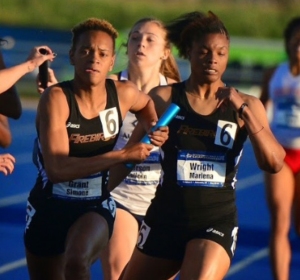
Wright (at right) hands off to anchor Simone Grant (at left) after running the 3rd leg of the 4x400M Relay at the 2014 NCAA Championships. Championships
By her senior year, Wright was a member of 11 different campus clubs/organizations and held leadership positions in five of them. She was Founder and President of the Video Club, President of the Literary Club, Multi-Media Chairperson for the Campaign 9:30, and Secretary for both Active Minds and Students Overcoming All Risks (SOAR). She also participated in Honor Society, Women of Worth (WOW), Photography Club, Student-Athlete Advisory Committee (SAAC) and the Student Judicial Board.
Meanwhile, she created and produced two athletic department video series called The Real MVP and Hammer Time, and she continued to spearhead track and cross country team and athletic department community service events.
“Marlena took ownership of her entire collegiate experience, and she became an extremely capable, outstanding young woman,” Director of Athletics Patricia Thomas said. “Her development has been wonderful to watch.”
Best of all, Wright’s self-prognosis that keeping busy would aid her academic pursuits came true – she earned straight A’s in each of her final three semesters at UDC. This, while taking 18 credits at the end of her junior year, 21 credits in the fall of her senior year, and 22 credits to finish in spring 2016.
Wright considers earning her second consecutive 4.0 semester to be her greatest accomplishment off the track.
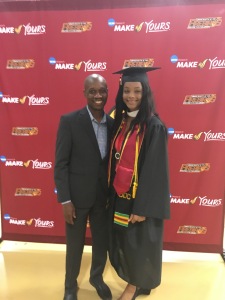
Wright and Coach Alton McKenzie before graduation.
“That was when I knew for a fact that I could do anything that I put my mind to. They usually say that the second win is the hardest, because now there’s so much more pressure involved. Receiving my second 4.0 was like winning our second ECC title – no one can say we, or I, got lucky. For me, getting those straight A’s was like winning a championship title, because I knew how hard I worked to achieve all that I did.”
The hard work more than paid off for Wright, who went on to earn a slew of awards this year including: the Reslyn W. Henley Memorial Award (the highest honor presented at the UDC Athletics Awards Banquet), the Excellence in Community and Character Award (the East Coast Conference’s most prestigious award for student-athletes), and the Arthur Ashe, Jr. Sports Scholar distinction from Diverse magazine. She has also been nominated for the 2016 NCAA Woman of the Year Award as of June, 2016.
As the honors and distinctions keep pouring in, Wright insists that everyone she came across at UDC had some kind of impact on her life. Still, there are a select few that stand out in her mind.
“Coach McKenzie definitely had a huge impact on me, because he was more than just a coach…he was like a father figure to me and my teammates. He was one of my greatest supporters on and off the track,” she said. “My teacher Lloyd Jones also had a great impact. He was the reason why I switched my major from Journalism to Television production. My boyfriend Phillip Foster also had a great impact on me. He was very supportive and very helpful. And my teammates, Simone and Jerily, have been there for me from the very beginning.”
Presently, Wright is working full-time with the Renewing Youth Foundation as a tour guide at the Frederick Douglas House. In addition, she is interning with Community Partners, where she focuses on fresh food access in underserved communities and mapping obesity rates. She will be creating a documentary on the Good Foods grocery store.
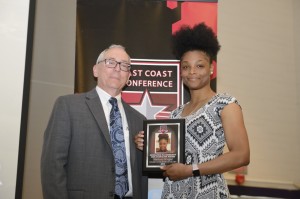
Wright with ECC Commissioner Bob Dranoff accepting the “ECC” Award.
According to Patricia Thomas, an athletic administrator for more than 30 years, it is precisely because of student-athletes like Wright that her work is so gratifying.
“The beauty of the whole process is that with Marlena…the best is yet to come,” Thomas said.
Wright recognizes she has come a long way since that fateful night Foster convinced her she could make a change. Therefore, her advice for student-athletes is also simple: “Don’t put yourself in a box – don’t limit yourself. Step outside your comfort zone. Be more than a student-athlete. Make it yours!”







 udcfirebirdblog